


National School of Civil Protection
Established in 1964, the school is a public institution of an administrative nature, possessing legal personality and financial autonomy. Its missions include:
Implementing various specialized training programs for recruitment into the ranks of medical officers, officers, and agents.
Organizing refresher and advanced training courses for senior staff, as well as officers and non-commissioned officers belonging to the various civil protection services.
Preparing and administering professional examinations specific to the sector.
Organizing external recruitment competitions for various ranks.
Training first response teams and classified institutions in the fields of prevention, security, and firefighting.
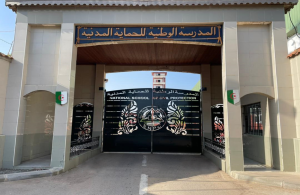
The school has several pedagogical facilities and support facilities that the trainee needs during the training period, which enable him to follow the training process comfortably and effectively, which are:
- A hall specialized in practical signage.
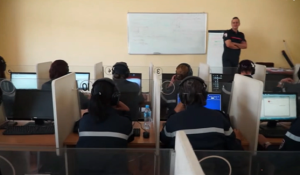
- A hall designated for study.
- Two (02) lecture stands with a total capacity of 500 seats.
- Simulator in forest fires and management
Crises.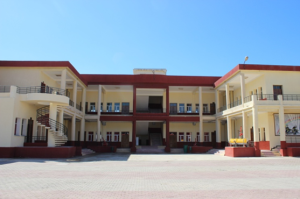
- Hall for automated media.
- A hall specialized in practical signage.
Applied business facilities: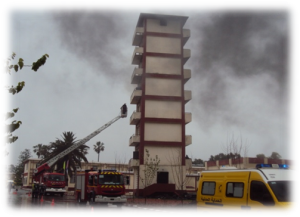
- A pedagogical unit with the necessary training facilities, including ambulances and trucks, for all specialties.
- Training field and mock maneuver tower.
sports facilities:
- Semi-Olympic pool
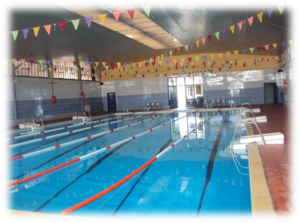
- Hall
- multi-sports hall
- Football field.
- Two (02) sports halls
- Two chess halls
- Semi-Olympic pool
Support facilities:
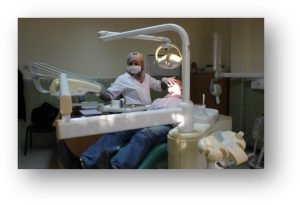
- Multi-service medical clinic (dentistry, general medicine, psychiatry, pharmacy).
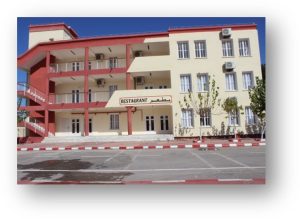
- Restaurant with a capacity of 400 seats.
- Two (02) entertainment halls.
- Accommodation suite (capacity 250 beds).
- Hostel (15 bed capacity).
- Barber shop.
- Laundry.
The National School of Civil Protection was supported by seven (07) regional annexes with a capacity of 250 trainees for each annex, distributed as follows:
- Eastern Algeria: Two regional schools (Annaba Province – Oum El Bouaghi Province).
- Western Algeria: two regional schools (Mostaganem Province – Sidi Bel Abbes Province).
- Southern Algeria: Regional School (Laghouat Province).
- Northern Algeria: Regional School (Algiers Province – Aïn Defla Province).
Within the framework of enrollment in the National School of Civil Protection:
- Organizes competitions and exams
- The school trains new students according to a specialized theoretical, basic and applied programme.
Within the framework of continuous training for the benefit of users:
- Organizes and ensures restructuring and level improvement courses for the benefit of executives and officers belonging to the sector
- It organizes complementary and specialized training courses
Within the framework of ongoing training for external institutions:
Preserving property and contributing to the national economy, the school forms executives and agents affiliated with public and private institutions in the field of prevention and security.
Within the framework of partnership:
- Establishing partnerships and exchanges with similar national and foreign institutions
- Organizes lectures and school days.
A- Rank of First Lieutenant Doctor: Training period is 10 months.
Main axes of formation:
Theoretical and applied formation:
The first stage: ambulance, rescue and firefighting.
The second stage: disaster medicine, medical emergencies, leadership and operations management.
The third stage: Risk Prevention, Anticipation
These stages include practical training at the level of practical units.
B-Rank of first lieutenant: training period is 12 months.
Theoretical and applied formation:
The first stage: – Ambulance, rescue and firefighting.
The second stage: – Leadership, operations management, prevention plans, prevention intervention, and risk analysis.
The third stage: – Maps and geographical information systems – Construction and architectural drawing. – Pollution and environmental protection.
These stages include practical training at the level of practical units.
C- Lieutenant rank: Training period is 12 months.
Theoretical and applied formation:
The first stage: – Ambulance, firefighting and rescue.
The second stage: – Command systems and operations management.
– Chemical and radiological hazards.
– Intervention and first aid plans for people, second level.
The third stage: – Risk prevention. – Combating forest fires. – Maps and geographic information systems. – Construction, reconstruction and road ambulance.
These stages include practical training at the level of practical units.
D – For employees: The training period is 12 months and is completed in regional schools.
Theoretical and applied formation:
The first stage: – Ambulance, firefighting and rescue.
The second stage: – Fire intervention techniques – Rescue techniques under the rubble.
The third stage: – Various intervention risks – Intervention systems and methods – Complex applied maneuvers
These stages include practical training at the practical unit level
The policy pursued by the General Directorate of Civil Protection in developing the sector was based on several aspects, including:
A- The organizational and administrative aspect:
The legal and regulatory texts of the National School of Civil Protection and the regional schools have been amended to keep pace with developments and create greater flexibility in training.
B- In addition to the structures and equipment:
The National School of Civil Protection and the regional schools were supported with various modern means of equipment and devices, as well as trucks and ambulances, specially prepared for pedagogical training, in addition to:
- Forest fire training simulator.
- Crisis management training simulator.
- Simulator for all possible dangers (multi-hazard)
C- Configuration programs:
Training programs for trainees have been modified to allow them to acquire professional skills and enable them to perform the tasks assigned to the civil protection sector.
In addition to the completed procedures and projects, and in order to ensure the continuous development of training programs, several projects have been programmed that are in line with technological development, including:
- Pre-hospital emergency simulator, a device for practicing diagnostic and treatment methods and medical decision-making in emergency situations.
- A simulator for training to confront chemical hazards.
- A technical facility for applied maneuvers that has eight (08) simulation workshops for various dangers.